

“Kfir was nine months old when he was kidnapped by Hamas. He’s spent half his life as a hostage.”
Tomer Keshet, cousin of Kfir’s father Yarden, sits in front of a poster of the now 17-month-old baby boy. Alongside the images of Noa Argamani being taken into Gaza on a motorbike, Naama Levy being forced into the back of a car, and ‘Lady in Red’ Vlada Patapov running for her life from the Nova festival, the toddler’s picture is one of the most hauntingly iconic images of the 7 October Hamas terror attack. The boy is lying on his back, big brown eyes sparkling, a toothy grin directed at the camera as he clasps a purple elephant toy.
The poster initially displayed his age as nine months. Since then, the number has been repeatedly crossed out and revised. It now reads 17. How many more times will it be updated before the fate of the youngest hostage held in Gaza is finally known?
On 7 October, the Bibas family, parents Yarden, 34, and Shiri, 32, and their two small children Ariel, four, and Kfir, were abducted from Kibbutz Nir Oz and taken into Gaza. They were among 252 people kidnapped on Israel’s darkest day. Since then, 112 hostages have returned alive to Israel – 105 through a prisoner exchange deal, four released unilaterally by Hamas and three rescued by the Israeli army.
For 53 days, Tomer, 34, and the rest of the family knew nothing about their loved ones’ fates. Then, on 29 November, following the release of 105 civilians during the temporary ceasefire agreement, Hamas claimed that Kfir, Ariel, and Shiri had been killed in an Israeli airstrike. The next day, a chilling Hamas propaganda video was released showing Yarden receiving news of his family’s death. However, without confirmation, no one in Israel, especially the Bibas family, is prepared to believe the claims of terrorists. Hope remains they might yet return home.
Speaking in an office near the Hostage Square memorial in Tel Aviv, Tomer’s thoughts return to the last time the family were all together, celebrating the Jewish festival of Rosh Hashanah, just three weeks before their nightmare began.
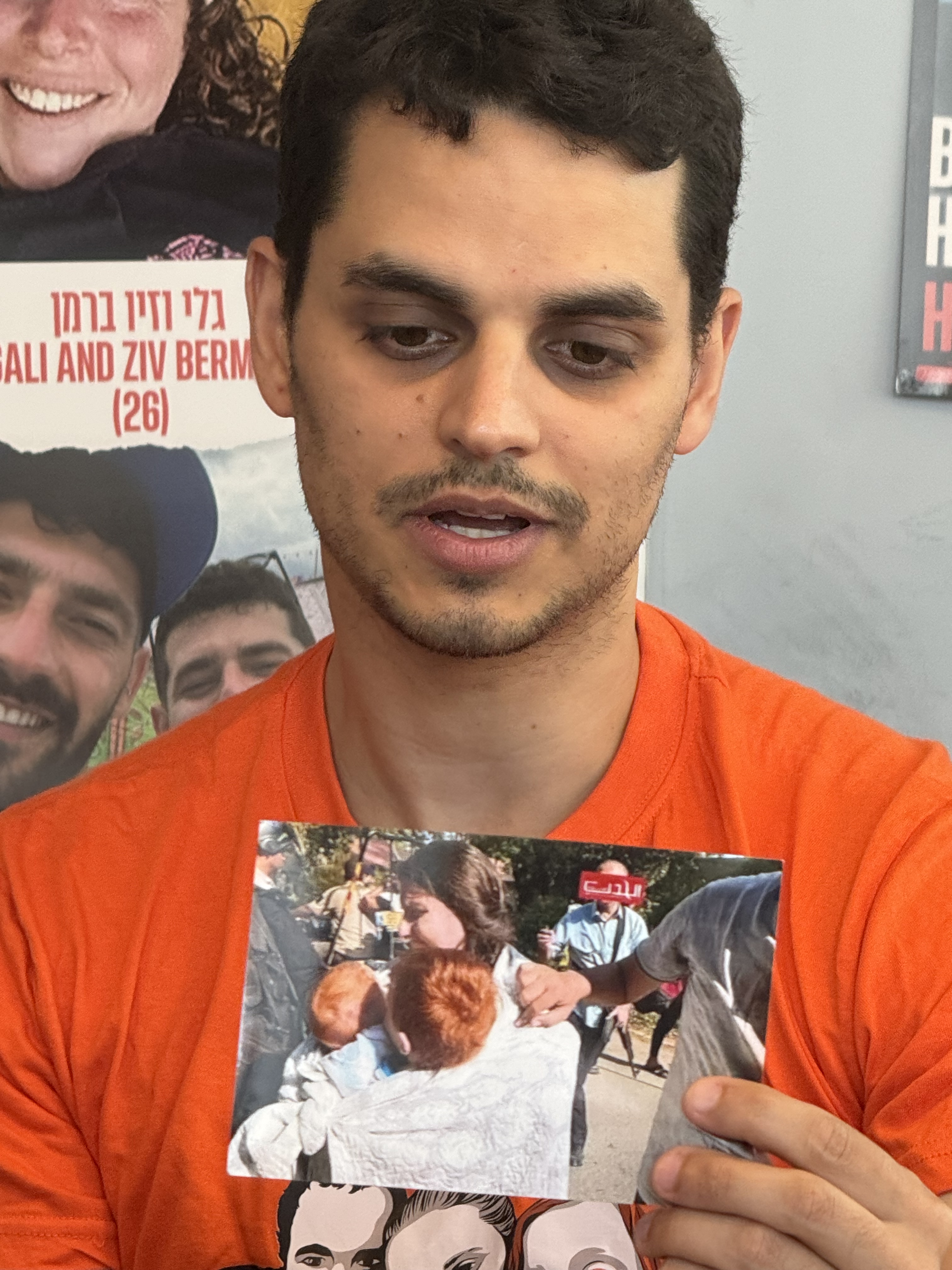
For 53 days, Tomer and the rest of the family knew nothing about their fates
“We are a large family. Israel is not a big place, but we are still spread around the country, so it’s special when the children come together for festivals. My children are a similar age to Ariel and Kfir so, like most big families, things tend to get a bit crazy and noisy.
“Shiri and Yarden are the kindest couple. They love to joke around and have permanent smiles. They don’t just smile for pictures. They smile for real.
“I remember being so happy. I can’t imagine feeling that way again. Kfir was so tiny. He could hardly stand. I can’t bear to think of him now. Perhaps he’s been kept in a crib all these months, not even allowed to crawl. He must be able to stand by now.”
Kfir turned one in captivity on 18 January, a day that was known in Israel as “the saddest birthday in the world”.
“It’s horrific to think he has spent half his life in captivity,” says Tomer. “We love him so much. He is such a calm and relaxed baby who loves to be held. But he can’t be the same baby now, kept in tunnels and dark places for such a long time. I fear he and Ariel will be forever changed. To kidnap a baby and a small child from their beds is completely against human nature. It’s not something I can begin to understand.
“Why doesn’t the entire world stop and say, ‘These are children dragged from their homes by terrorists! Why doesn’t the entire world condemn this and demand they return home with their mother and father? If this horror doesn’t shake people and force them act, what will?”
Tomer’s voice trembles as he points to the poster. “This picture was taken just before he was taken. He’s supposed to be playing with his brother, learning to walk and say ‘dada’, not being held hostage.”
Every Shabbat and Jewish festival since 7 October without his loved ones has been torture for Tomer. “There have been many so many landmarks since that Rosh Hashanah. Purim, Pesach. All of them without them. Every time I hear my own children laugh, every time we sit down together for dinner, every time I change a diaper, I see Kfir.”
Tomer shares his story alongside three other hostage families. There’s Yarden Gonen, sister of Romi Gonen, 23, who was taken from the Nova music festival, Ronen and Orna Neutra, whose 22-year-old son Omer is an IDF tank commander, and Ayelet Svatitzky, sister of British-Israeli Nadav Popplewell, 51, kidnapped from Kibbutz Nirim. Ayelet’s mother, Channah Peri, was released on November 24 as part of a temporary ceasefire deal. Her older brother, Roi Popplewell, 54, was killed on 7 October.
Tomer takes a deep breath as he recalls that fateful Shabbat morning. “I live in the centre of Israel and woke to the sound of alarms. I went into the bomb shelter with my family and sent a message in our family group asking if everyone was all right. I got a thumbs up at around 7am, but then we lost communication.”
It wasn’t until those now infamous clips of Shiri and her children being taken from their home appeared on social media that Tomer realised what had happened. “You can see Shiri holding her children so close to her chest, trying to defend them. She’s horrified. She knows things are not looking great. We know Shiri and the kids arrived in Gaza, but we have heard nothing from them since.”
Weeks later, footage was released of a bleeding Yarden being driven into Gaza on a motorbike.
Shiri’s parents, Margaret and Yosi Silverman, who lived on the same kibbutz, were murdered and their bodies found near the Gaza border. The Bibas family’s beloved dog, Tony, was also shot dead.
Kfir and Ariel are the last two child hostages still being held. “We hoped that because they are so young, we would get them back in the November release,” says Tomer. “That was a long time ago. Each passing day fills me with more fear. Ariel and Kfir have distinctive red hair. We’ve been sent pictures of red-headed children in Gaza by people hoping they might be Ariel and Kfir. None of them were. Yet, with each picture, we are reminded there is love and concern for them, which gives us a glimmer of hope.”
First published by Mail Online

 GeT RICH QUICK
Leave a comment